Asymco

Asymmetric Competition


The next 100 million iOS devices part II

Brian Marshall, an analyst with investment firm Gleacher & Co., predicts that Apple will have sold 200 million iOS devices by this time next year. He expects the iPhone and iPad to represent 68 percent of gross margins for 2010.

via Apple’s mobile OS could move to more devices.

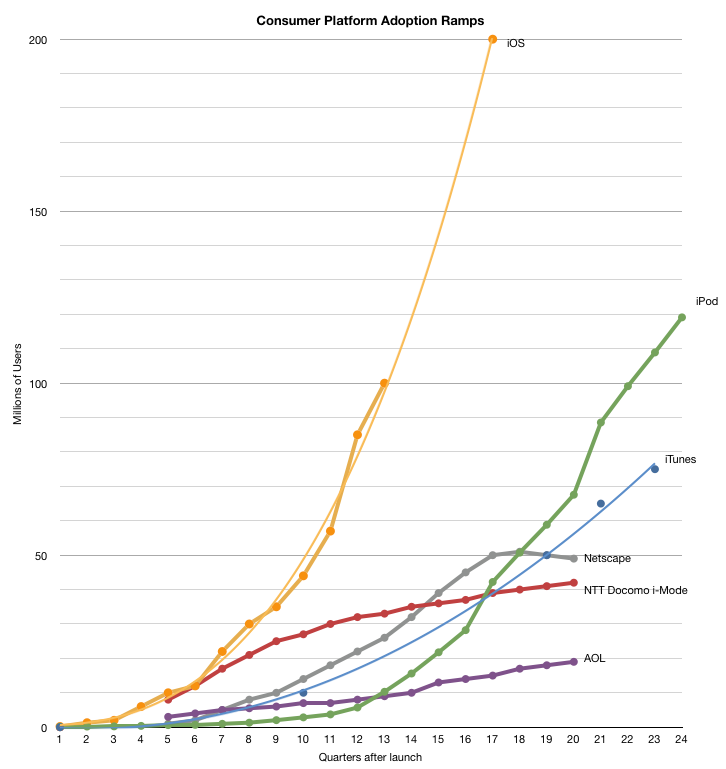
My expectations for the next 100 million were made in June:

My expectation is that well over 100 million iOS devices will sell during 2011, but even during the next 12 months (2H ’10 and 1H ’11) the total may well reach 100 million, making 200 million installed by June 2011 very likely.

The next 100 million iOS devices

My current expectation is that iPhone and iPad will account for 70 million additional iOS units for the twelve months following this June quarter. This excludes any Apple TV units moving to iOS.

As iOS moves to more of the iPod line-up it’s quite possible that another 30 million iPads with iOS will ship in the same time frame making Marshall’s forecast sound reasonable.

Discover more from Asymco

Subscribe to get the latest posts sent to your email.


19 responses to “The next 100 million iOS devices part II”

  1. In calendar 2010, Apple should sell more than 75 million iOS devices –
    25-30 million iPod touchs ( from the iPod Average Selling Price and figures from Apple)
    40-50 million iPhones
    10-15 million iPads
    Obviously much of the final figure depends on July-December sales and production rates. When Mac sales of around 15 million are included, Apple can reach 100 million iOS/ OS X sales this year. More details in http://lowendmac.com/nash/10tn/100-million-os-x-d

  2. […] Read more from the original source: asymco | The next 100 million iOS devices part II […]

  3. The combination of Apple's discipline, iterative approach to improvement (constant improvement) and economies of scale on MULTIPLE LEVELS (software and hardware) make them very hard to beat. Plus they are a marketing marvel!

  4. Is the KIN phone included in the chart above and just too small to be visible?

    (Sorry, couldn't resist 🙂

    1. Good one!

      Though, to be fair, I'd be interested in a similar trendline for, e.g. Windows XP.

      1. Focus here is on "consumer platforms" with some mobile flavor. XP is such an infrastructure building block that it does not compare.

  5. Interesting graph. Is NTT Docomo i-mode a service or phone OS? If it is some kind of service for cell phones, there are some interesting trends there. I would be curious to see a trend line for PCs – not to compare absolute numbers, but the growth trends. It would also be interesting to look at the trend lines for cloud services – particularly Gmail.

    If the PC trend line is like that of Netscape or AOL, it speaks a lot to where the future is headed for consumer devices and the cloud services tech companies are racing to build to serve these computers/devices.

    If it were not for iOS devices, iTunes would probably have a similar trendline as AOL and Netscape, I think. Rumors suggest Apple is going to unveil a cloud-based iTunes on Sept 1. How long before Apple completely drops the PC/Mac umbilical cord for its iOS devices?

    1. We already have iWork on the iPad. Once the rest of iLife comes to an updated iPad with video, iTunes drifts in the cloud, and MobileMe works just fine between all these MDs, there will be precious little need for a computer.

  6. Tom, the dreamer Avatar
    Tom, the dreamer

    Fast forward to May of 2011: you are using your new iPad 2, reading someone's blog, when an iAD for FaceTime appears below. You click to see what's up. A video in HD begins: a stage with 5 people. They are scattered about, two standing, two on chairs, one on a couch in front of a TV. A spotlight highlights the first, an iPhone user. He initiates a face time call to — another iPhone. Second iPhone puts first on hold, and calls iPod touch. Original caller is brought back in briefly for a three way chat. Someone — iPod touch — remembers something, drops out of conference to call iPod nano and iTV user, who then calls original iPhone. On the TV screen, we see the iChat version of a 4 way conference! No computers in sight! Apple educating iOS users on the value and functionality of FaceTime.
    Of course iPad 2 initiates a face time call to three others, all on various iOS devices on wifi.
    The only part of this dream that remains in the dark is doing this on 3G.

  7. […] Documenting the ramp up in iPhone/iPad use.  (asymco) […]

  8. I have to point out the obvious elephant in the room – Apple still doesn't seem to have an answer to surging Android sales from margin-self-starved competitors.

    1. Not sure Apple wants to change its already given answer: move more n more people onto iOS in more n more ways. Apple is not self starved for profit or mindshare. Market share as these charts show is following along quite nicely, thank you very much!

    2. Android and handset makers are going for market share at any cost (or in this case, no profit). Apple is doing it profitably.

      Who do you think will be able to win this battle long term? It's not all about *just* market share. You have to be able to do it so that it is sustainable long term. Or you end up like being Dell – no R&D expertise, pushing out Android 1.5 devices that no one will buy due to lack of apps, because no developer is going to put out an app that supports 1.5 and older.

      1. I am just wondering if Apple will be able to sustain profit margins.

      2. People have been asking that same question with regards to iPod and Mac computers. As long as Apple continues to innovate, the margins will be fine.

  9. Sevket Zaimoglu Avatar
    Sevket Zaimoglu

    If you look at the sales growth of Android, it is even more spectacular. Here is a screen cap from Vic Gundotra of Google's presentation from late May 2010:
    http://twitpic.com/2jw06n

    You can watch the full presentation at:


    Mind you, the 100 thousand plus units per day being activated refers to late May, and from an interview of Eric Schmidt, it is nowadays about 200 thousand units per day.

    For a better perspective, the iOS devices graph here is a cumulative graph while the Android graph shows the rate of change. From a freshman physics analogy, the iOS graph represents the distance (x) while the Android graph represents speed (dx/dt).

  10. Sevket Zaimoglu Avatar
    Sevket Zaimoglu

    Have you seen the AdMob Metrics Report for May 2010? It contains loads of useful information:
    http://metrics.admob.com/2010/06/may-2010-mobile-

  11. […] took the venerable Consumer Platform Adoption Ramps chart and added Android and the latest data on iTunes, iPod and […]

  12. Congratulations! Your estimate for 200 million iOS devices by June 2011 has been spot on:
    6 June 2011: "While whipping the black sheet off iOS 5 at WWDC 2011 today, Apple's Scott Forstall gave delegates a quick run down of some key figures, including the fact that Apple has now sold over 200 million iOS devices." http://www.techradar.com/news/software/applicatio

    But then, Andy Rubin's latest tweet that there are now over 500 thousand Android devices being activated each day means that Android will reach 200 million devices in 2011 alone: http://twitter.com/#!/Arubin/status/8566021347830

Leave a Reply

Your email address will not be published. Required fields are marked *

This site uses Akismet to reduce spam. Learn how your comment data is processed.

Discover more from Asymco

Subscribe now to keep reading and get access to the full archive.

Continue reading