Asymco

Asymmetric Competition


The app industry vs. the music industry

By my estimate, Apple has paid out $16.6 billion to content owners. $2.5 billion to app developers and about $14 billion to music companies. The developer payments are published by Apple, the music payments are estimated based on total downloads and guesses about the split and pricing of that content (90% for the content and $1 to $1.2 average pricing over time.) There might be reason to move the music figure up or down but the difference will still be nearly a factor of 5.

The cumulative payments are shown in the following chart:
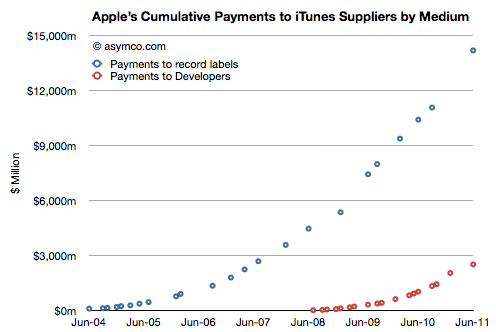
From this perspective, the music business is still a far bigger ecosystem than apps. However that’s cumulative data and digital music has been around far longer. The story can be told a different way: What’s the rate of sale in the present period? From what we know about the business, we can see what Apple takes in for apps and music (I’ve already estimated what Apple “keeps” after paying content owners)

The combined “sales rate” is a remarkable $665 million per month, but the split now is that music generates only twice the income of apps (i.e. cumulative is a factor of 5 but on a monthly basis the factor is 2). But what should be more impressive is how quickly the app business is ramping. By the slope of the trend lines, it would appear that app income will exceed music income within three years. Therefore, it’s only a matter of time before apps generate as much income (exclusive of advertising) as music.

Another perspective is the number of downloads per device per month. This shows that the rate of consumption of apps is increasing and is now about 6 apps per device per month.

(You have to think of apps not as traditional computer applications or console games where each device has a certain number of expected apps attached, but rather that apps are more like a subscription where there is recurring monthly income).

I don’t have a comparable figure for music because the number of iPods and Macs as target devices is hard to estimate, but I doubt consumption for music on a per device basis is increasing. As a consolation, I can estimate the number of apps or songs per iTunes account. Here the story is consistent.

Each iTunes account has “consumed” about 67 songs but also 62 apps. Remarkable parity in such a short time. And the trend speaks for itself.

All this data points again to the ascendancy of apps as a new medium. In a mere three years these digital objects have redefined themselves. They went from being tools to enhance the use of your phone to a new medium of expression and art. They have the ability to create a powerful economy of their own and will likely lead a profound shift in where value resides in mobile computing.


Discover more from Asymco

Subscribe to get the latest posts sent to your email.


41 responses to “The app industry vs. the music industry”

  1. I think another important point is the apps cut goes directly to developers and the companies actually producing the products, while the record company money gets further divided with the actual makers of the product getting a significantly smaller fraction.

    It'll probably take 20 years but I expect the music market to move more towards the app market method rather than the other way around.

    1. 20 years is a very long time. I have to wonder how much longer the music industry will exist in its present form. Already the companies that make up the industry are in a state of distress and are not investment grade.

    2. Agree. The music industry should do away with the middlemen who are not rewarding the artists the way they should be rewarded. The result is a definite drop in the quality, quantity and value of the good consumed. This will in the end result in the demise of the industry as a whole.

      1. The music industry ARE the "middlemen who are not rewarding the artists…". They will not do away with themselves. ITunes has some chance to do so, if indie artists who publish directly to iTunes are awarded proper money.
        Without the music industry middlemen there could be less trash that only exists because it is promoted by big money, and more quality music that exists because people actually like to listen to it.

        But it is going to take a looong time.

      2. "Less trash…more quality music"
        Having worked in a similar field (magazine publishing), let me disagree with this thought. The easier it becomes to publish music, the more trash will be published. Most fiction writers are lousy, and most musicians are lousy. Publishers select only a few of each to publish, and for the most part they actually do select the most talented. Depressing, but true.

        Occasionally a real talent is overlooked or doesn't fit the "corporate model", but the ideal of the coffee shop guitarist whose talent and soul exceed all is pretty much a fantasy; the reality is millions of semi-talented hacks who will never get past playing "Louie Louie" in a smoky bar on Friday nights. Middlemen prevent the market from being flooded with utter junk.

  2. I'd be interested to know how people purchase music. I buy albums. But do normal people tend to purchase only single songs? If most people are like me, it's easier to pull the trigger on a $2 app than commit to a 10 dollar album. But there is more turnover in the app business. I rarely buy an album I don't get _some_ listening in on, but there are plenty of apps I've bought and never use.

    Plus, you have to consider that people can download songs from the Zon as well as other places and put them on their iOS devices. This is just "iTunes" business right?

    But I think with the upcoming changes to iOS 5 it's going to change the rules a bit. Purchasing an album on iTunes and having it show up on all your devices automatically is a feeling that cannot be described in a Keynote.

    interesting though.

    1. Ever since the iTunes era began, albums have declined in popularity. The essential value of digital downloads was the lower price point for consumers seeking songs (vs. being forced to buy albums). I don't have specific data handy but I believe the following site does: http://www.ifpi.org/content/section_statistics/in

  3. "music payments are estimated based on total downloads and guesses about the split and pricing of that content (90% for the content and $1 to $1.2 average pricing over time.)"

    One source to get some insight into this is TuneCore. They are a service for independent artists to get their music to online stores. If you scroll down a little bit, you get to the part where they list pay rates for iTunes: http://www.tunecore.com/faq#StoresOverview
    It looks pretty much like the same 70-30 cut, but of course big record companies have more negotiating power and might have different contracts with Apple.

  4. People are going to look back on this era as the Renaissance of software development, after the long Wintel darkness. The last time this many diverse applications were appearing on the market was in the late '80s-early '90s, and this is a torrent by comparison. And it's still early days…

  5. Not sure if you took it into account but iTunes Music store is not available in all the same countries as App Store. So purchased music/app ratio may be skewed as buying apps is actually more wide spread than buying music (via iTunes of course).

  6. And following both Eric D and Piotr I would say the evidence HD gave us earlier in the year shows that music downloads are fading and Apps are in a very early stage. All businesses follow the 'S curve growth and then decline' model, only the time alters. Maybe music is near the top of the S. Lack of innovation, conversion to digital from the 60s/70s boom largely over, ennui. Apps are at the bottom.

    I'm going long on Apps and short on music.

  7. Great data points, but there's more to the music industry than the recorded music industry as stated in these numbers. As the incremental revenue models for recorded music continue to decline independent of the medium, it will be extremely important for artists to continue to seek new streams. Apps provide a valuable opportunity for artists to monetize themselves beyond just their music in entirely new ways. Considering that our mobile phone is the most important device we own, apps will become the dominant way we interact with content, services, and each other. The key for artists is to find a way to differentiate in the app marketplace just as they do in the music marketplace by providing a memorable and engaging experience.

    Cheers,

    Ivan

  8. The labels perform a great service in selecting, promoting, developing bands. I have no idea whether they are worth 10% of what they get, but a Blue Note or Concord jazz release gets a listen where a BrandX … well, it has to be driven by hearing the artist. Radio also performs that function, but we all know how badly radio has been ground into the dust.

    In steps Apple with its apps, and IT has become the label. For a 30% cut, they curate, cultivate, run QC, then promote, categorize and provide marketing for the developers.

    Apple has a huge share of the app market — Horace, I'd LOVE to see swags of the entire industries here — but perhaps not until it gets to be a larger share of the music market will it be possible to take on the labels' role.

  9. I wonder what happens when iTunes Match becomes available to the mass public, considering Apple is the biggest music retailer.

    Perhaps a sustainable music industry business model (subscription + purchases)?

  10. Apple has truly, as you mentioned above. And while there are "boutique" labels that feature high-quality (and reliably so) material – the vast majority of the market lies in the pop category and the quality there is mitigated only by its volume and turn-over. Indeed if you were to ever able to have a candid conversation with a music exec you would be shown that the whole reason for albums was to publish add-on material with the most popular cuts driving the purchase of said album. I think the music industry, short of turning itself inside out it going to slowly trash itself to death and carry quite a few popular and talented musicians along with it. Boutique labels can react to market changes more quickly, and while not having the same margins are closer partners to the musicians, and more open to the shifting paradigm.

    1. @PatrickG, it's not always the case that “… the whole reason for albums was to publish add-on material with the most popular cuts.”
      .
      A whole album more nearly replicates the experience of a live performance, concert or club. I like the mix of jazz on my favorite KCSM but really treasure the dates where I got to see somebody like Brubeck or Chick Corea play a range of material live. An evening at home listening to “greatest hits” from famous operas is nowhere as satisfying as a recording that reminds me of a great live performance I caught of “Die Valkyrie.”
      .
      The album makes sense once you think of the mental energy to decide whether to buy ANY chunk of music or not; better to do that once instead of a dozen times. While you don't get the Top 40 experience that way, you get to hear what a band is up to. I suppose that's why I buy CDs from Amazon and rip 'em once to iTunes and never touch 'em again, versus using the track-oriented iTunes approach.

  11. Umm insert "disrupted the tradition album sale model" after truly above – apologies.

  12. […] sobre o conteúdo do iTunes Apple Store desde o seu início, de acordo com uma interessante análise por Asymco de Horace Dediu. Mesmo que isso envolve uma série de conjecturas e olhando dentro da […]

  13. It would be intresting to see how the iTunes compare in sales to rest of the music industry. They always talk about pieces and months not the money generated and not consideret that what is the netto profit of that sales. I  Horace 😉

    1. With lots of typos ;D

    2. About 85% of paid downloads are through itunes.

  14. […] App Store will overtake the iTunes Music Store in monthly income for Apple in the next three years, estimates Horace Dediu at Asymco after analyzing the data on […]

  15. Interesting data sets.

    Its worth noting that there are several fundamental differences between the App market, and that for media such as songs and movies.

    The most important of which is that the App Store is essentially the ONLY place one can acquire apps. Music, by way of contrast, can be acquired by ripping CD's, swapping MP3 files, etc. It would interesting to know what percentage of the typical iOS device's music collection was acquired through iTunes – but my guess is the number is around 10%.

    The subscription factor is going to help the App economy ramp extremely quickly. A relatively "low cost" news subscription, costing a dollar a week, is going to add up to $50 per user per year. I doubt even the most dedicated Lady Gaga fan is going to spend $50 a year on her songs on iTunes.

    But long term, the key to continued growth in the App economy is going to be a steady stream of new devices, with greater capabilities, which will give customers an incentive to upgrade the Apps they run on them.

  16. […] to industry analyst Horace Dediu, Apple users are really embracing apps in a big way, and he projects that by 2015, Apple will be making more money off of apps than iTunes music […]

  17. […] The amount of money made by app developers will exceed those collected from music downloads within the next three years. This is the conclusion made by a new survey entitled, “The app industry vs. the music industry,” by asymco. […]

  18. […] The amount of money made by app developers will exceed those collected from music downloads within the next three years. This is the conclusion made by a new survey entitled, “The app industry vs. the music industry,” by asymco. […]

  19. […] The amount of money made by app developers will exceed those collected from music downloads within the next three years. This is the conclusion made by a new survey entitled, “The app industry vs. the music industry,” by asymco. […]

  20. […] per jaar kost. Vrij snel daarna komt het bedrijf alweer met interessante cijfers: volgens hun berekening zullen de inkomsten van apps binnen drie jaar groter zijn dan de inkomsten van muziek uit de iTunes […]

  21. App downloads are purchases only, no updates.

  22. […] kunnen de inkomsten van de App Store die van de iTunes Store gaan overtreffen. Dit blijkt uit een analyse van […]

  23. […] The new form of sharing information and writing reports will be the App. The market for Apps has grown since the launch of the Apple App Store exponentially and has been supported by the launch of even […]

  24. […] kunnen de inkomsten van de App Store die van de iTunes Store gaan overtreffen. Dit blijkt uit een analyse van […]

  25. […] скорее, — учитывая общее падение продаж — все получается с точностью до наоборот: What it does do, […]

  26. […] en  iOS descargaba aproximadamente  60 apps superando la venta de canciones en  Itunes. Según Asymco, ese número de apps va a ser superado muy pronto. Y eso sin contar las descargas ilegales como se […]

  27. […] It was only a few weeks ago (at WWDC) that we had an update on the app store growth rates. The data was presented here. […]

  28. I really enjoyed this piece. I would love to see how the statistics look next year.

  29. Scott in Sydney Avatar
    Scott in Sydney

    Are you saying there is currently a 90% split to the content companies (record labels)? If so, where did you get that figure… “and guesses about the split and pricing of that content (90% for the content “

    1. The discussion of split for iTunes was taking place in 2004. I seem to recall that the split was about 10% to Apple but the question of how much payments cost and how much labels got is unanswered. Since writing this post I’ve received more information about payment overheads and I would reduce the label gross to about 70%. It would make sense to revisit this and track down more data.

Leave a Reply to Kristian Cancel reply

Your email address will not be published. Required fields are marked *

This site uses Akismet to reduce spam. Learn how your comment data is processed.

Discover more from Asymco

Subscribe now to keep reading and get access to the full archive.

Continue reading