Asymco

Asymmetric Competition


Understanding Apple's Organizational Structure

Apple has hired a new VP who will report directly to Tim Cook. Paul Deneve is cited as having responsibility for “special projects” and will report directly to Tim Cook.

The previous roles as a manager in luxury brand companies has led to a great deal of speculation about what new projects Apple could be working on that might also fit this new manager’s background and title.

The most commonly cited speculation is around the iWatch or TV product lines (with some surprised that he will not be heading Retail.)

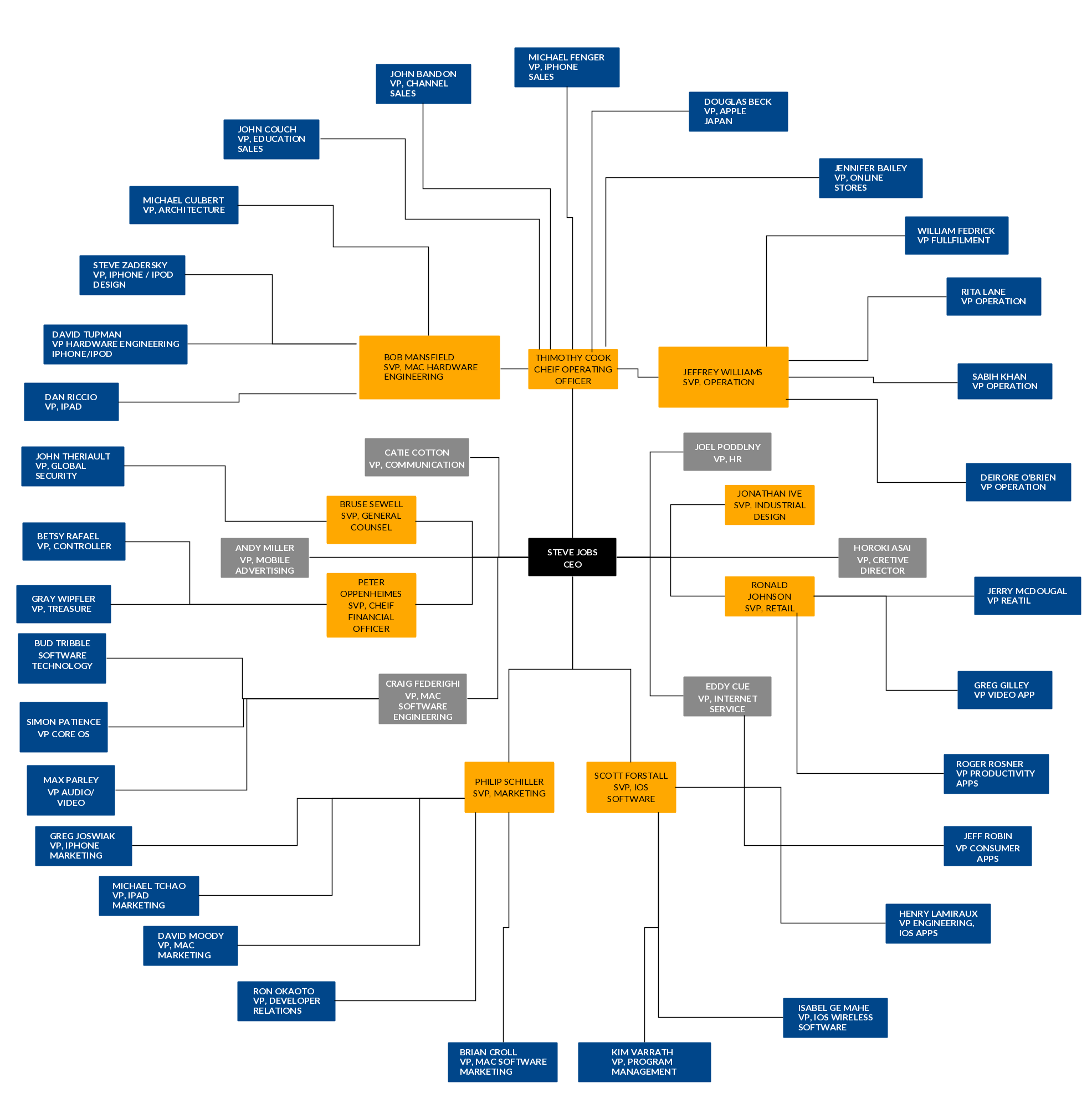
Although reading “luxury product CEO” and concluding “new luxury products” seems logical, a little knowledge about how Apple is organized dispels this notion. And a little knowledge happens to be about all we have, as Apple’s organization is one of its most closely guarded secrets. Even employees at Apple have little idea of how the company is organized. What we do know is summarized into this org chart:

Screen Shot 2013-07-03 at 7-3-3.37.27 PM

I’ve taken the liberty of splitting Tim Cook’s direct reports into “Disruptive” and “Sustaining” functions—which I admit is a bit cheeky—but the point is to separate the product creation functions from the management and administrative functions of the organization[2].

When seen in this light, the first observation is that there is no “product business” ownership. Schiller’s Marketing function includes product marketing by product line, but these are not business ownership roles (product marketing mostly deals with how products are positioned, promoted, priced, etc.)

There is no “head of devices” or “head of iPhone”. Put more plainly, there is no organizational consistency with how the company reports its financial performance.

So it would make little sense to add a new direct report to this chart that did have a specific product ownership (or creation) role. Product is a “horizontal” responsibility for which every function is partially responsible.

In lieu of this, my reading of the chart shows another function for which there seems to be no leader: brand. Brand management is a crucial function in consumer-facing companies, and many brands-oriented companies orient their organizations (and power) around brand mangers.

In years gone by I would have said that Brand management was Steve Jobs’ direct responsibility. Today I would say that it’s something that needs a direct manager. This is something for which Paul Deneve might be well suited.

Notes:

  1. The last chart published on this topic is from 2011.
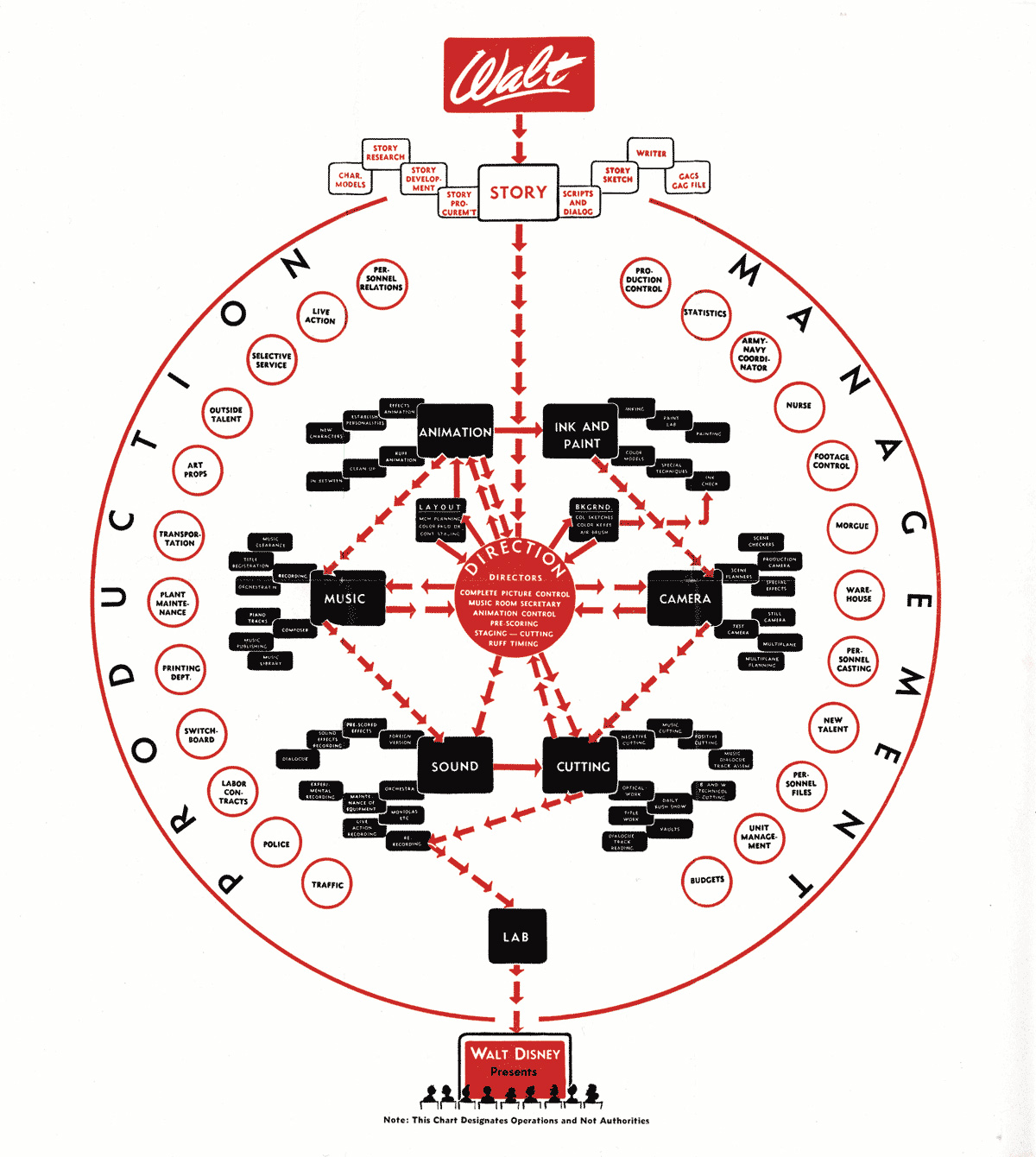
  2. With inspiration from Disney.

Discover more from Asymco

Subscribe to get the latest posts sent to your email.


64 responses to “Understanding Apple's Organizational Structure”

  1. What is communications and operations? I’m a little bit confused why operations is on the disruptiv side

    1. I’m a little bit confused why operations is on the disruptiv side

      If that’s true then you haven’t been paying attention to Horace, have you?

      1. I don’t know much about Apple’s operations, but it seems they have been doing disruptive things behind the scenes. Shifting functions from FoxConn to Pegatron, chip fab, mfg in US – nothing stays the same for more than a few years.

      2. Diversifying suppliers is sustaining. If Foxconn fails, iPads still get manufactured and Apple doesn’t fail.

      3. Also, could be some of the manufacturing techniques like the aluminum milling or internal architechture are considered disruptive vs sustaining. Retina displays, high-pixel cameras, battery technology.
      4. Would you mind explaining? I know Horace has this view, but I don’t know in what way apples operations side is disruptive.

      5. The ideas are
        (a) Apple uses its excess cash as part of a rather new business model. The cash is used not to buy new factories in Apple’s name, but rather to buy factory equipment which is held in some joint relationship with Apple’s manufacturing partner. This allows Apple and its manufacturing partners to split responsibilities more so than has been the case in the past; to put it bluntly it allows the manufacturing partner to do what it is good at (lower costs, large number of employees, how to handle various materials, etc) while at the same time not holding Apple back because of the limitations of these manufacturing partners (not much capital, so limited ability to expand fast and into new areas).

        (b) These ever more aggressive manufacturing techniques are a competitive advantage. In a short five years we’ve gone from phones that have potential — but are so slow and limited in so many ways — to phones as dream machines with all the must-have features in place and working. Which means that over the next few years competition will operate on slightly different grounds, there won’t be the pressure there has been for an upgrade every year.
        One way Apple counters this commodification is with devices that are just that much more beautiful (in terms of how they are manufactured) than the competition.
        HTC tried valiantly with the One to create something comparable, and probably lost a ton of money in the process. (Much their own fault — you need the whole package; the nice hardware AND the reputation that you will stand by your devices longterm.)
        Samsung has not yet tried to compete on this dimension (and given the hash they are making with their Galaxy S4 branding, by the time they do the message will doubtless be so confused no-one will understand it).
        I haven’t seen the latest Lumia’s in real life so I can’t comment on Nokia’s efforts in this regard.
        Sony has a long track record of making beautiful devices when it wants to. It could probably do the equivalent of HTC, only with a device that was more originally beautiful, not just a visual clone of the iPhone. But Sony has the same problem as HTC that this is only part of the package — they don’t have the reputation that they will stand by their phone still offering SW updates four years later.

        Point is:
        – a new way of sharing costs and equipment with manufacturing partners (operations) leads to
        – a way to compete (among the customers Apple is targeting, those wealthy enough to pay a little more for beauty) which appears to be difficult to reproduce. It’s expensive enough to reproduce the manufacturing, and just that is not enough, you also have to reproduce the SW experience, the brand trust, the SW updates, if you want those same customers.

      6. Thanks for the thoughtful response! I agree that is asymmetric vs the competition, especially when looked at as a part of the bigger picture.

    2. Communications is Corporate Communications and it functions like Public Relations. The VP has been Katie Cotton for a long time. I would think she is heavily involved in branding.

      Operations covers the production of all Apple products, which of course includes the whole supply chain. Cook began as the VP for that; Jeff Williams worked under Cook and has been the SVP for a while. How Apple gets its products made, especially the high volume ones, is a critical part of being disruptive.

      1. thank you, this helped a lot!

  2. Immediately thought of this. (image attached)

  3. Immediately thought of this…

    1. Weird that it is thought of us an unconventional when pretty much every company looks like this.

      1. Most large companies do not look like this. As Horace said in this and previous posts, those lines from Jobs do not go to product divisions with profit-and-loss statements, but rather to functional organizations. Just about every organization works on every product, so all functions are invested in seeing every product succeed.

  4. Steven Lachance Avatar
    Steven Lachance

    (1) Wouldn’t branding fall under marketing and Schiller?
    (2) How likely is it that Apple would bring in an outside guy to lead one of the most important long-term assets it has? If feels un-Apple-like, no? It’s something they cherish and invest in so much, why gamble it on a new guy?

    1. brand is also a horizontal responsibility. I would thing, it’s about wearable technology, but there a clearly some overlaps with ivys position as head of design.

    2. “How likely is it that Apple would bring in an outside guy to lead one of the most important long-term assets it has?”

      That “outside guy” started his career at Apple Europe…

      1. He spent 7 years at Apple EU. Hardly an outsider by any stretch.

    3. Onafunjourney Avatar
      Onafunjourney

      To be unApple-like is the very essence of Apple.

  5. As a former Apple employee most people do know what the org chart looks like. And it is structured around the financial approval lines. Basically some in the company report to Tim Cook and most to Peter Oppenheimer.

  6. I hope his special project will be redesigning iOS 7.

    1. Space Gorilla Avatar
      Space Gorilla

      Nitpicking aside iOS 7 looks great. The multiple layers concept seems well suited to larger screen iOS devices, which I expect we’ll see more of.

      1. …and smaller screens…

      2. Space Gorilla Avatar
        Space Gorilla

        Yes, thanks, smaller screens as well, forgot to mention that. The whole ‘panes of glass’ or ‘stack of cards’ concept is great for different form factors.

      3. Perhaps not. Parallax requires wide borders to give the layers room to move.

  7. There is no point in looking at Apple in the hope of finding familiar/comfortable MBA-school prescribed ideal business structures. It may get to that the same day that the company loses its mojo. I believe that Jobs learned to respect the necessary rigours of good business management but I don’t believe he ever relented in his disdain for formal structural alignments.

  8. Having worked for NASA, the organization looks somewhat like a matrix organization with most of the technical disciplines in the software and hardware group supporting the design group. The power in NASA usually resides in the project offices (Shuttle, International Space Station). They control cost/schedule/performance for development of a project/brand. The downside is the project offices only care about their project and not NASA. For Apple, I would speculate that the Project function(or Brand Function) resides in the Design Group. By having the right person overseeing the brand/project function and having them all in one group, you might avoid the individual kingdoms by project/brand that get formed in a company/organization. It appears that this is what Apple is trying to do and seems to have been very successful so far. The proof being the tight integration across products. Within NASA, the strong Project Offices impede this tight integration and sharing of technologies. With design working closely with hardware and software engineering you will get this horizontal integration as long as the individual that ultimately controls development of a particular product (e.g. IPhone 5S) doesn’t have too much power to prevent the horizontal integration where it makes sense.

  9. […] 但是要彻底研究透苹果这种体量公司的组织结构,那非得出一本书不可。那么下面来自 asymco 的一张图或许能帮助大家对苹果的结构有个初步了解。 […]

  10. […] 但是要徹底研究透蘋果這種體量公司的組織結構,那非得出一本書不可。那麼下面來自asymco 的一張圖或許能幫助大家對蘋果的結構有個初步了解。 […]

  11. […] 但是要彻底研究透苹果这种体量公司的组织结构,那非得出一本书不可。那么下面来自 asymco 的一张图或许能帮助大家对苹果的结构有个初步了解。 […]

  12. The organization is patterned after a Lean management style, where there is a lot of cross functionality, and resources are allotted based on need.

  13. Thank you for this post. I was not thinking of overall brand, but you are right. There doesn’t seem to be a brand person around since SJ died. It seems TC is bringing someone in to perform a function he cannot.

  14. […] Asymco recently took a closer look at the organizational structure phenomenon at Apple. Here is what you need to know: […]

  15. Here’s a more complete list of Apple’s key staff from Reuters: http://www.reuters.com/finance/stocks/companyOfficers?symbol=AAPL.O&WTmodLOC=C4-Officers-5

    1. Space Gorilla Avatar
      Space Gorilla

      No it isn’t, it’s the same list with the directors and the general counsel added.

      1. Yes it is:

        Jeff Williams, 49, Senior Vice President – Operations

        Plus I do consider the directors to be “key staff” but your mileage may vary.

      2. Space Gorilla Avatar
        Space Gorilla

        The chart above has Operations, just not the name of the person. I already noticed that. Not much of an oversight. So by ‘more complete’ you actually mean ‘one small omission’.

        And no, I don’t consider directors to be key people in the day to day operations, because they aren’t. My mileage of course does vary because I’m powered by truth.

      3. Onafunjourney Avatar
        Onafunjourney

        Good that you guys settled this. There is no better use of this board than chest pounding over who posted the most complete list, unless o course it’s sarcastic replies at their expense.

      4. Space Gorilla Avatar
        Space Gorilla

        Indeed. I really shouldn’t reply to annoying pedants, but I couldn’t help it in this case. I mean come on, blah blah blah here’s a more complete list, look at me correcting Horace Dediu bleeh blah blooh, and it turns out there’s *one name* not noted on the original chart.

      5. Oh, man. I was just trying to be helpful. Horace mentioned “And a little knowledge happens to be about all we have, as Apple’s organization is one of its most closely guarded secrets.”, and a few seconds later, while checking the stock, I happened to stumble upon that list and posted the link. No chest-pounding intended. And since a list that contains (even a little) more info is more complete than one with less, I wrote that down. Again, any apparent chest-pounding was unintended and if maybe my reaction to being scoffed at was too harsh, I apologize.

  16. Horace, in terms of the creation of a position that determines or controls “global branding”, vague as that is, I would think that the personal aesthetic of Jobs was stimulated by his intimate creative and personal relationship with Lee Clow at what is now TBWA/Chiat Day, similar in its intensity to his creative relationship with Ive. We often overlook the deep foundational involvement of non-Apple personnel like Clow and Esslinger as in effect off-site extensions, or auxiliaries, of Apple culture, and to some extent, its articulators if not authors. I haven’t seen any detailed, “insider” accounts of this chemistry (Isaacson doesn’t really go there), and the longevity of the client/agency relationship (approx. 4 decades) warrants deeper understanding.

    My point is that there is something significant in Apple’s structure when it decides to go “in house”, as it eventually did with industrial design, yet has never done with advertising and possibly “branding”, as that overlap of Apple’s internal graphic design and creative direction and the work of external firms remains unclear.

    In short: Does this hire represent Apple going in-house with something?

  17. Bill Esbenshade Avatar
    Bill Esbenshade

    Deneve may be a great sounding board for Jony Ive, much like Steve Jobs used to be. Deneve could really help Apple in matters of taste, which obviously impacts brand value.

    A more multidisciplinary approach (Ive with design and Deneve with fashion) could produce some really innovative ideas.

    1. My guess would be they just wanted a deeper design bench. Ive is going to be harder and harder to keep at Apple and in the United States and it’s better to bring someone on before the need is critical. In the meantime he will be involved in some future-looking projects.

  18. Paul Stringer Avatar
    Paul Stringer

    If Apple move into wearable computing e.g. Watches which are currently mostly worn as fashion would it make sense that they bring this guy in to bring that experience.

  19. […] 但是要徹底研究透蘋果這種公司的組織結構,那非得出一本書不可。那麼下面來自 asymco 的一張圖或許能說明大家對蘋果的結構有個初步瞭解。 […]

  20. Doesn’t that structure also have significant disadvantages ? I’m thinking of
    – dropping the Server market, after assurances to the contrary.
    – weak “pro” desktop products. I’m aware of the new Potted Plant model, and it’s nice, but it was overdue by several years
    – iffy “pro” software. I’m not very up to date on this, but it seems Apple are moving everything downmarket.

    Obviously, Apple are doing very well as is. It does seem they exited the Entreprise business, and not because it was insufficiently profitable, but because they didn’t have the bandwidth to take it on. Nor the motivation, probably, as it is not a very ego-boosting business either. Isn’t that what a functional organization does: delegate minor markets that aren’t worth the praetorians’ (divas’ ?) time. And maybe train new praetorians (divas ?) in the process ?

    1. Yeah, that is perhaps exactly what they did. You raise an interesting point: Perhaps we can look at not only org structure from functional vs divisional perspective, but also products from those perspectives as well. But what you apparently see as a disadvantage or weakness, may just as well be a strength.

      I think it is “divisional” to look at products in terms of broad category or market such as “server” or “Enterprise”. I think this is how other companies naturally look at their products — along their own org divisional lines. And this is why they have crises and have to make major adjustments when the markets change. It’s a fickle approach. Such as IBM or Dell retreating from the “consumer space” (or even retreating from computers) and moving to Business Services. This is why MS and Google are entering the hardware space, because their divisional thinking needs expansion when the times are not so good or the markets are changing (ie PC to post-PC/Mobile).

      So, lack of bandwidth may have something to do with it; conversely, that means Apple has focus. It may simply be the case that Apple long ago recognized what others are discovering: that orienting products to functions is better in the long run. As opposed to trying to cover a whole broad market, Enterprise, and all its myriad requirements. Like, not making a device that is supposed to be both a mobile touch device for consumers and an enterprise device (yes, I am thinking of the Surface, a product that is no good for either market). No sense in trying to “serve” that segment just for the sake of having something in that space, whatever you have offered there before.

      Therefore, I think what Apple has done makes good sense: looking at products and services from a Functional perspective helps focus them, helps Apple refine them, helps Apple say no to spec bloat for the sake of it, etc. Yes, surely, this is largely related to their being more functional oriented as a organization as well.

      So, rather than saying, let’s make a “server” or support the “enterprise”, Apple says, “what industries or functions CAN we support?” Obviously, film editing, DTP, education, small business, etc. are some of those functions Apple feels it can comfortably address. Surely, that is an advantage or a strength? [moving things “downmarket” entails a lot more discussion].

      Then, high-profile and head-line grabbing or not, Apple does enjoy large sales to certain functional segments of the market: 30 thousand Macs for *students* in one school district, 40,000 Macs or iPads for *salesmen* at one company, Macs or iPads for a whole government department, Macs for design studios, Macs for film studios, iPads for in-flight entertainment for whole airline fleets, iPads for point-of-sales for whole retail chains…

      1. Space Gorilla Avatar
        Space Gorilla

        Exactly. The iPad, which is consumer-facing (but highly functional and flexible), is doing very well in enterprise. There’s a revolution happening with the iPad, and it seems to me a lot of analysts are missing it. I still see people dismissing the iPad as a toy or a consumption tool, but five years from now the ‘computing landscape’ is going to be very different. You think Apple is big now? Wait five years.

      2. airmanchairman Avatar
        airmanchairman

        To buttress the points made by these 2 insightful posters Kizedek and Space Gorilla, I posit the statistic of around 45,000 iPad apps (at last count) serving the Medical and Healthcare industry alone as an indicator of Apple’s incredible enterprise drive from an unusual, functional angle…

      3. airmanchairman Avatar
        airmanchairman

        “You think Apple is big now? Wait five years”

        With the expected advancement in CPU, battery and general manufacturing technology, plus way more OS know-how, would we by then start to see the emergence of true multi-user, high productivity app-running (i.e. Pro/Enterprise) versions of the iPhone and iPads?

      4. Space Gorilla Avatar
        Space Gorilla

        I expect some kind of iOS Air ultrabook soon. It makes sense. At the very least a larger screen iPad. I currently use an iPad 2 in a ZAGGFolio as my portable business computer, it’s very natural. iOS 7 also seems like a natural fit for larger screens (smaller screens as well). This shift is sneaking up on most people. I see plenty of analysts wondering what Apple’s next big product is after iPhone. It is right in front of them and they don’t see it (iPad).

      5. airmanchairman Avatar
        airmanchairman

        iPad 3 in a bone-white Targus Versavu 360 with Bluetooth keyboard here; I can remote or console-log-on to Cisco, Juniper and Brocade routers and switches and HP/Dell/Linux servers via an amazing variety of secure web, 3rd party apps and dongles. Administer my home LAN from an airport lounge, plane cabin, train coach or platform; stream/channel-flip my Satellite TV box from wherever I please over Wi-Fi or 3G. Not to mention Corporate email, calendaring and Intranet browsing (via Good for Enterprise).

        You’re right, the future is a larger Retina iOS 7 screen, and is closer than many suspect.

      6. Spike McLarty Avatar
        Spike McLarty

        Reading this comment two years later (2015) – looking pretty smart already, Space Gorilla.
        Here, have a banana 😉

      7. Space Gorilla Avatar
        Space Gorilla

        Thanks, yum!

  21. Also, I’d put “retail” into the “disrupt” category.i know it would ruin the graph’s beautiful symmetry, but, talking to customers and thinking about it, hundreds of manufacturer’s shops is original and important.

  22. Is the new Microsoft organization a move in this functional direction?

    1. Based on what Ballmer said,.. Looks like he has been reading Horace and wants Microsft to be more like Apple.

      Good luck with that.

  23. […] Asymco Analizi : Apple’in organizasyon yapisi […]

  24. […] message and brand across all of Apple’s products. Renowned Apple analyst Horace Dediu at Asymco points out that Apple has “no ‘product business’ ownership.” Instead, “Product is a ‘horizontal’ […]

  25. […] App Store, iPad. All of these offerings were facilitated by the company’s now celebrated functional structure, but none of them were created by the reorganization. Put another way, functional structure is a […]

  26. Very interesting chart. I have recently found a site that shows what is an organizational chart and has different templates for making one. I have found the site very helpful when making my org charts.

  27. Hello! It seems that the org chart image is broken. Can you upload it again, please? Thanks so much.

Leave a Reply to orienteer Cancel reply

Your email address will not be published. Required fields are marked *

This site uses Akismet to reduce spam. Learn how your comment data is processed.

Discover more from Asymco

Subscribe now to keep reading and get access to the full archive.

Continue reading